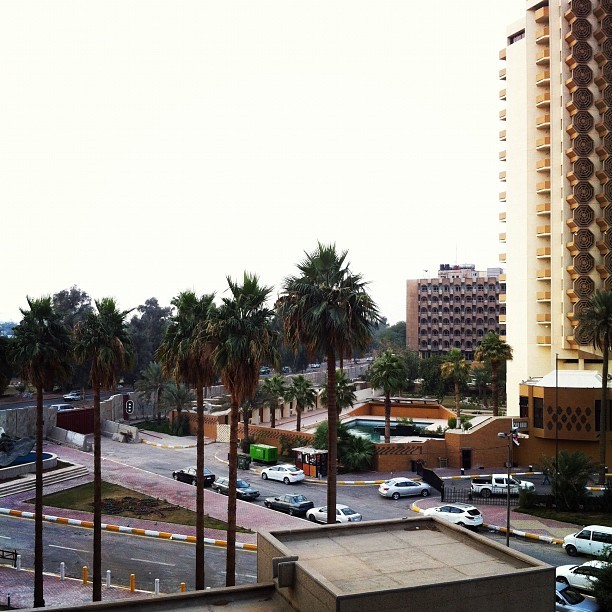
Taken at International Zone, Baghdad


We usually tend to remember only success, but learning and innovation comes usually from failure. Today people only see Apple as the highly successful company for last 8 years, but on 2001 still Apple was in red. What can we learn ? Innovation is the key and not just the cost, only creating products with high value for customers will succeed.
We see lots of new apps coming with augmented reality AR, this one shows an amazing way to provide guidelines for in-car navigation, really closest to what a ‘natural’ guidance should be in a car.
No distractions, simple, clear.
Augmented reality is following the principle that when the technology is not seen by the user, is when perception becomes ‘natural’; you can see in the attached videos the concept and technology MVS gives the name of Virtual Cable. Really cool.
Taking some words from MVS site “… eyes on the road, hands on the wheel and mind on driving …”
It is obvious that such guidance requires the best in class and accurate navigable database with all the information digitized for roads and streets. Such database will not be seen but will be there providing the ‘knowledge’ to the system.
See more in www.mvs.net and do not miss the technology videos explaining the concept http://www.mvs.net/technology.html
Education is in a huge disruptive time. Generation Y, the native digital scholars do need diferent ways for learning. Access to knowledge is becoming more easy through the net and the traditional teaching process must change to follow up the new disruptive digital environment.
GIS training is in a similar disruptive time. Maps, GPS, check-in and location apps are becoming natural part of end-users. As Dr. Armando Guevara says : “success of technology is when it is not seen”.
The challenge for people coming from the cartographic world will be how to convert such complex and sofisticated GIS technology, based on deep cartographic knowledge, to develop value added applications and services for end users.
When I built my home some years ago I asked to the architect why the name was ‘H Arquitectes’, why the ‘H’ in front of the name. The answer was amazing : “the ‘H’ is a letter that is there but you do not perceive (never pronounced in Spanish and Catalan) So, our architecture is designed and created in a way that you perceive the beauty but do not realize is there” http://harquitectes.com/
I believe that principle must also be applied to technology when delivered to end -users : must be there but not perceived.
Just do it for all GIS and new cartographic and location world.
This is the challenge.

 Antoni Barniol